%20(1).jpg)
“In my business, transcripts are invaluable. You can’t put a price on being able to go back and say: ‘No—this is what you said, word for word.’”
About the Business
Matthew Fernandez is a native New Yorker who started in real estate in 2013 and now runs his own commercial real estate firm in Manhattan. He works across the full spectrum of commercial brokerage: office leasing, retail leasing, building sales, office condos, and more.
The Challenge
Commercial real estate is a communication-heavy business. Deals move through fast conversations, shifting timelines, and constant inbound inquiries. For Matthew, the biggest operational risks aren’t strategic—they’re about organization and communication.
The volume alone creates pressure. Handling 300 to 500 calls a week makes it extremely difficult to retain accurate information. Even a short call generates follow-up work: logging the interaction, writing notes, updating the CRM, deciding next steps, and remembering exactly who said what and when.
Before Beside, this process was largely manual and error-prone. The team used HubSpot, but without consistent and complete logging, the system often failed to reflect reality. Missed calls made things worse. In brokerage, unanswered calls can directly translate into lost opportunities, and voicemail rarely fills the gap—many callers simply don’t leave one. The result is a costly mix of lost leads, missing context, and time wasted reconstructing conversations after the fact.
“Did you ever lose business because of missing calls? Yeah — all the time.”
%20(1).jpg)
The Switch
Matthew discovered Beside through targeted ads while frequently searching for M1 Finance, back when Beside was still known as M1. He adopted it while building the operational foundation of his new venture, looking for a way to elevate how inbound communication was handled.
What mattered most wasn’t novelty or experimentation—it was whether the system worked in real conditions. Early on, Matthew pressure-tested Beside by having friends call in, paying close attention to how the conversations felt and what details were captured.
“It was memorable… because it’s something you’ve never seen happen before. But the biggest thing is that it worked.”
The Transformation and Impact
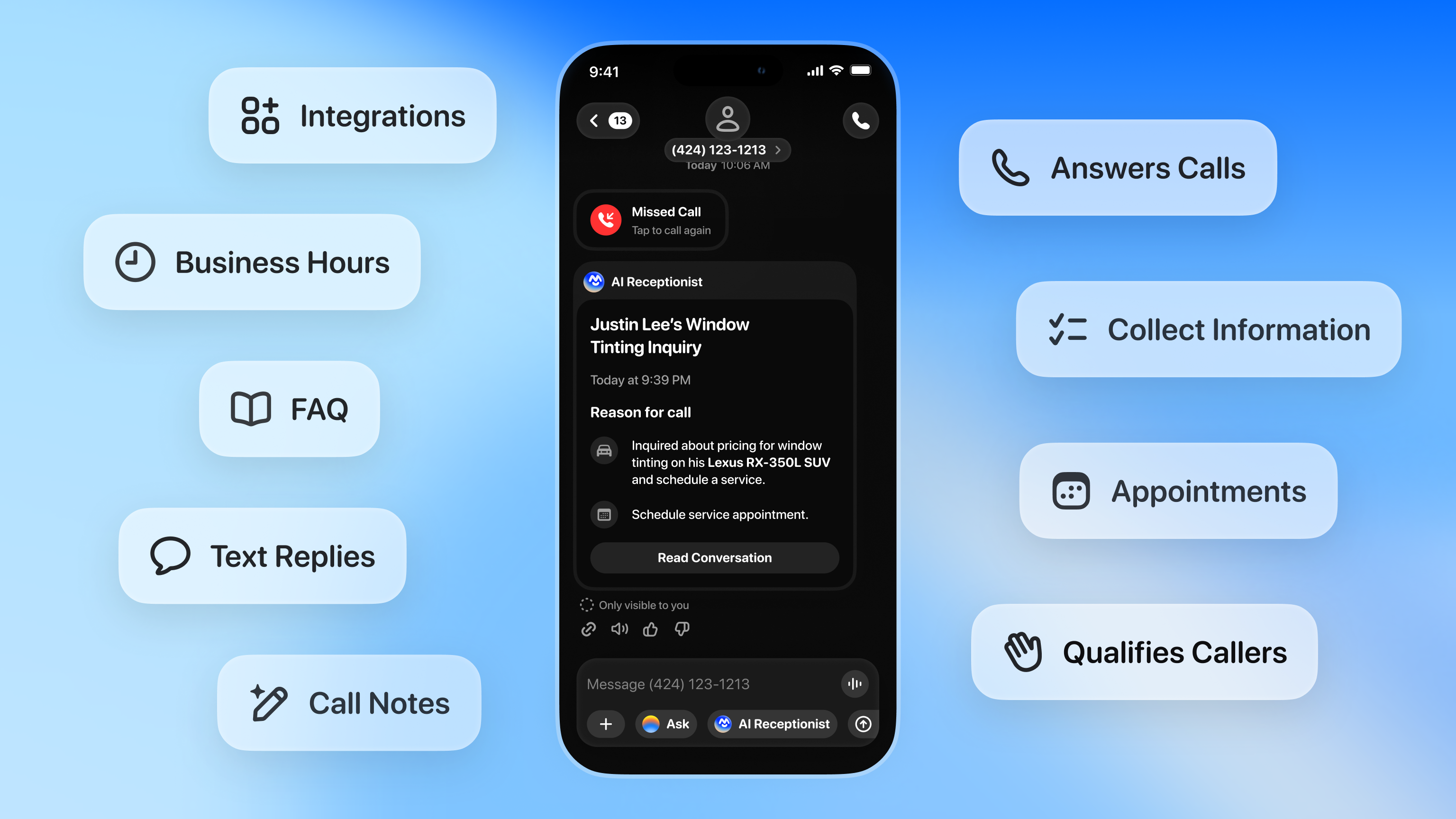
Beside changed the system from “manual memory” to automatic capture + searchable accountability.
Instead of relying on hand-written notes and best-effort logging, Matthew now gets:
- summaries that preserve intent and tone,
- full transcripts that eliminate ambiguity,
- voice recordings for extra clarity,
- workflows that drive faster follow-up.
In a world full of “he said / she said,” Beside acts as a neutral record of conversations. For Matthew, transcripts make it possible to hold people accountable by preserving exactly what was said. In commercial real estate, that clarity isn’t a gimmick—it’s leverage. It reduces disputes, limits confusion, prevents backtracking, and helps decisions move faster.
How a day feels now
A call comes in while Matthew is juggling multiple threads—clients, agents, listings, negotiations, and internal coordination. In his old workflow, every call triggered a small administrative project before any real work could begin.
Now, Beside acts as an intake layer. It answers when Matthew can’t, captures key details even if a caller drops quickly, and preserves enough context to make the next step efficient. That same logic extends to text-based inquiries. When a prospect texts a number listed on a property, Beside can respond automatically, confirm a showing window, and in some cases add it directly to the calendar—capturing leads without slowing everything else down.
“The automated response and the text message agents are pretty useful for lead capture.”
.jpg)
This matters because real estate is full of “in-between” moments—someone sees a listing, texts quickly, and moves on. If you respond late, you lose momentum.
What this changed
- Fewer lost opportunities — even when callers won’t leave voicemails, Beside captures the initial intent and contact info.
- Less manual logging — summaries reduce time spent writing call notes and updating systems.
- Real accountability — transcripts and recordings prevent “memory battles” and support clean follow-up.
- Faster turnaround — quicker responses across calls and texts improves customer service consistency.
- Hours saved weekly — Matthew can’t quantify an exact number, but describes it clearly as hours per week.
Working on the Business, Not Only in It
Matthew makes a simple point: everyone has the same 24 hours. Growth depends on how that time is used. Beside doesn’t create revenue on its own, but it frees up time for higher-level execution—where real growth happens. Over time, saving just a few minutes of administrative work per call compounds into hours reclaimed each week, which can then be reinvested into expansion, new business lines, and increased deal velocity.
“Growth is a direct correlation of your ability to have more time to execute on high level things.”
%20(1).jpg)
How Matthew Personalized Beside
Matthew’s use case is high-volume, high-context, high-stakes. The features that matter most in his workflow:
- Summaries for speed — faster follow-up without rebuilding context.
- Transcripts for precision — eliminate ambiguity and protect against misremembered claims.
- Searchable call history — recover context across hundreds of weekly touchpoints.
- Text agent for lead capture — instant response to listing texts and showing requests.
- Calendar integration — confirms appointments and reduces coordination friction.
He also describes a power-user workflow: using Beside as an internal memory layer to connect opportunities across conversations. If someone calls about selling an office building, he can quickly ask Beside who he has previously spoken to about buying similar properties. That capability goes beyond convenience—it’s a real workflow upgrade. Paper notes can’t do this, and a CRM only works if logs are perfectly maintained. Beside makes it practical in day-to-day operations.
The Human Story
Matthew’s business is built on relationships and trust—but it runs on information: who called, what they said, what was promised, what changed.
Beside helps him stay responsive without being consumed by constant inbound. It keeps the “human touch” consistent—even when humans can’t be perfect every time.
“With the personalization built into the app, you can get pretty close to replicating a human touch.”
At a Glance
- Business: Commercial real estate brokerage & advisory (New York City)
- Team: 10 core agents + ~30 marketing staff (~40 total)
- Call volume: ~300–500 calls/week
- Before: Manual call notes + CRM logging; missed calls = lost opportunities
- Setup: Automated call answering, transcripts, summaries, text agent, calendar integration
- Impact: Hours saved weekly, better organization, faster follow-up, stronger accountability